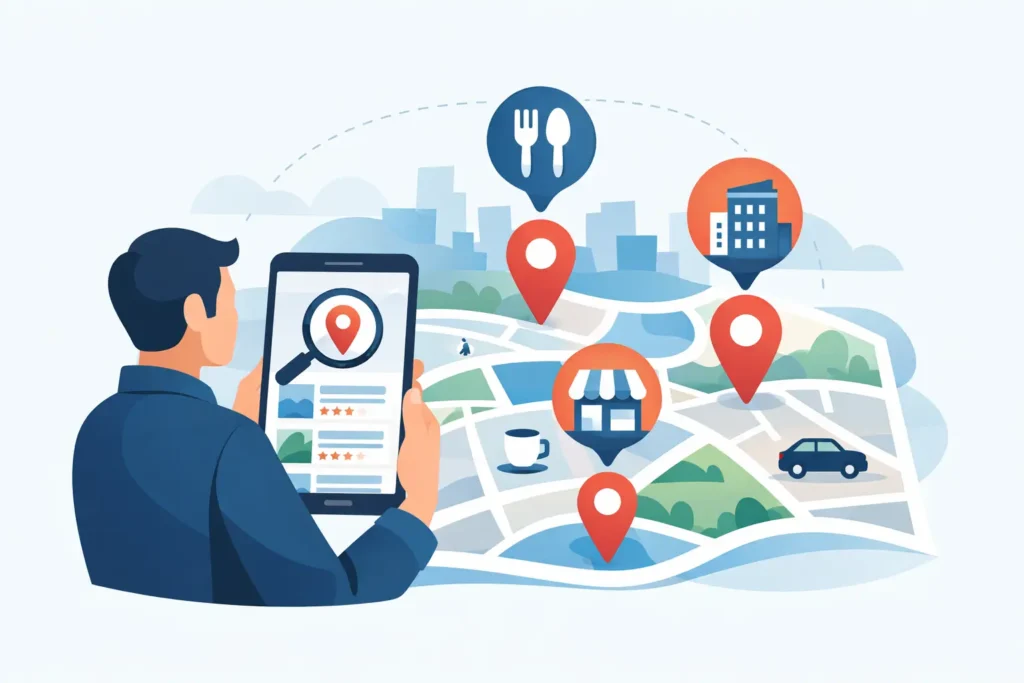
A prospect standing in a parking lot, phone in hand, searching for a service near them is not browsing. They are deciding. That is why near me search optimization matters so much for local businesses. It targets the highest-intent moments in search and turns them into calls, form fills, direction requests, and booked jobs.
Too many businesses treat local SEO like a loose collection of tasks – update a profile here, add a city page there, ask for a few reviews, then hope rankings improve. That approach creates activity, not a system. If you want predictable lead flow from local search, you need engineered alignment between your website, your Google Business Profile, your location signals, and your conversion tracking.
What near me search optimization actually means
Near me search optimization is the process of improving your visibility for location-based searches where users want a nearby solution now or soon. Some of those searches include the words “near me.” Many do not. Google often applies local intent automatically, even when someone searches for terms like “roof repair,” “emergency plumber,” or “best dentist.”
That distinction matters. If you optimize only for the literal phrase, you miss the bigger opportunity. The real job is to help search engines understand three things clearly: what you do, where you do it, and why your business is the best result for that searcher at that moment.
This is where many campaigns break down. A business may have decent service pages but weak location relevance. Or it may have a complete Google Business Profile but a slow website that underperforms on mobile. Rankings in local search are rarely the result of one factor. They are the output of a connected system.
How Google evaluates local intent
Google usually weighs local rankings around relevance, distance, and prominence. That sounds simple until you start working through what each one actually includes.
Relevance is about fit. Your categories, services, on-page copy, titles, schema, and supporting content all help search engines understand whether your business matches the query. Distance is exactly what it sounds like, but it is not something you can fully control. If a searcher is across town, a competitor closer to them may have an edge.
Prominence is where execution compounds. Reviews, citations, backlinks, branded search demand, website authority, and real-world business signals all contribute. A stronger brand with better local trust signals can outrank a closer but weaker competitor.
That is also why there is no honest version of local SEO that guarantees top placement for every near me query. Geography introduces variability. But you can absolutely increase the surface area where your business appears and improve the conversion rate of the traffic you earn.
The assets that move local rankings
Your Google Business Profile is a primary ranking asset
For most local businesses, the Google Business Profile is the center of near me search optimization. It feeds the map pack, supports branded and non-branded discovery, and often becomes the first thing a buyer sees before they ever visit your site.
A half-complete profile leaves money on the table. Category selection, service definitions, business description, hours, photos, review velocity, Q&A coverage, and post activity all influence how competitive your listing is. Accuracy matters just as much as completeness. If your hours, address, service area, or phone number are inconsistent, trust drops.
Your website validates and expands local relevance
The profile gets attention. The website closes the gap between visibility and action. Strong local landing pages, fast load times, mobile-first design, clean technical structure, and location-specific service content all help confirm your relevance.
This is where a lot of businesses underinvest. They rely on a homepage and assume Google will connect the dots. Sometimes it does. Often it does not. If you serve multiple cities or neighborhoods, your site should reflect that with intent-driven pages built around real services and real geographies, not spun location content written for search bots.
Reviews are ranking signals and conversion assets
Reviews affect both visibility and buyer behavior. Google reads them as trust and prominence signals, while users read them as proof. Quantity matters, but quality and recency matter too. A business with 150 reviews from three years ago is not necessarily stronger than one with 75 recent, detailed reviews tied to specific services.
If you are not actively generating reviews through a repeatable process, your competitors are creating distance. Near me search optimization is not just technical. It is operational.
Near me search optimization on the website
There is a difference between adding city names to pages and building a local search engine that produces leads. The second approach starts with service architecture.
Your core services need dedicated pages. Those pages should clearly state the service, local coverage, outcomes, and trust signals. They should be supported by location pages where geography materially changes intent, demand, or competitiveness. In many cases, a business also needs supporting content that addresses adjacent searches, common objections, and high-value informational intent.
Technical execution matters here. Schema helps search engines interpret your business data. Internal linking helps distribute authority and clarify page relationships. Site speed affects user engagement and mobile performance. Title tags and headers still matter, but they work best when the underlying page is actually useful.
The trade-off is that more pages are not always better. Thin location pages can hurt more than help. If you create ten city pages with the same copy and no unique value, you are not building relevance. You are manufacturing duplication. The better path is fewer, stronger assets that match real demand and real service coverage.
Why tracking matters more than rankings alone
A lot of agencies stop at visibility. That is not enough. If local SEO is going to earn budget and leadership confidence, it has to connect to lead generation and revenue.
That means tracking calls, form submissions, booked appointments, and channel-assisted conversions. It also means understanding which services and locations produce qualified demand, not just traffic. A page that ranks well and brings in low-intent visitors may look good in a dashboard but do little for the business.
The strongest near me search optimization programs are built around attribution and forecasting. You want to know which ranking movements correlate with more calls, which profile actions lead to booked jobs, and where to invest next. That turns SEO from a vague marketing expense into an acquisition system leadership can make decisions around.
Common mistakes that suppress local visibility
Some local SEO issues are obvious. Others quietly stall growth for months.
One common problem is inconsistency across the web. If your business name, address, phone number, and service details vary from one platform to another, Google gets mixed signals. Another is category misalignment inside the Google Business Profile. Businesses often choose broad or inaccurate categories, then wonder why they do not appear for high-value searches.
The website introduces its own problems. Slow mobile performance, weak internal linking, poor page targeting, and missing local schema can all suppress results. So can vague copy. If your site talks about being “trusted” and “committed to excellence” but says little about actual services, locations, and outcomes, it is not helping search engines or users make a decision.
There is also the issue of treating AI content like a shortcut. AI can accelerate production, but local search still rewards specificity, clarity, and trust. If the content feels generic, it will struggle. If the content is structured, locally grounded, and aligned to search intent, AI can absolutely support scale. The tool is not the strategy.
A better framework for local businesses
The smartest way to approach near me search optimization is to treat it like infrastructure. Start with your highest-value services. Map them to the cities or service areas that matter most. Build or improve the pages that support those combinations. Align your Google Business Profile with the same service priorities. Then put a review generation and conversion tracking process behind it.
From there, you optimize in cycles. Improve rankings where you are close to visibility. Expand geographic coverage where the data supports it. Strengthen pages that bring traffic but underperform on leads. Add schema, speed improvements, and conversion elements where technical gaps exist.
This is where a systems-oriented agency has an advantage. When strategy, implementation, and measurement live in one operating model, the work compounds faster. That is the difference between one-off SEO tasks and an SEO engine. For businesses that need local search to produce real pipeline, that distinction matters.
If your market is competitive, expect nuance. Some services will rank faster than others. Some nearby cities will convert better than the city with the highest search volume. Some map pack wins will come from profile improvements, while others will require stronger site authority and better local content. The right answer is rarely one tactic. It is coordinated execution.
Near me searches happen at the moment a buyer is ready to act. If your visibility, site structure, and tracking are built to capture that moment, local SEO stops being a branding exercise and starts driving the kind of lead flow you can actually plan around.