

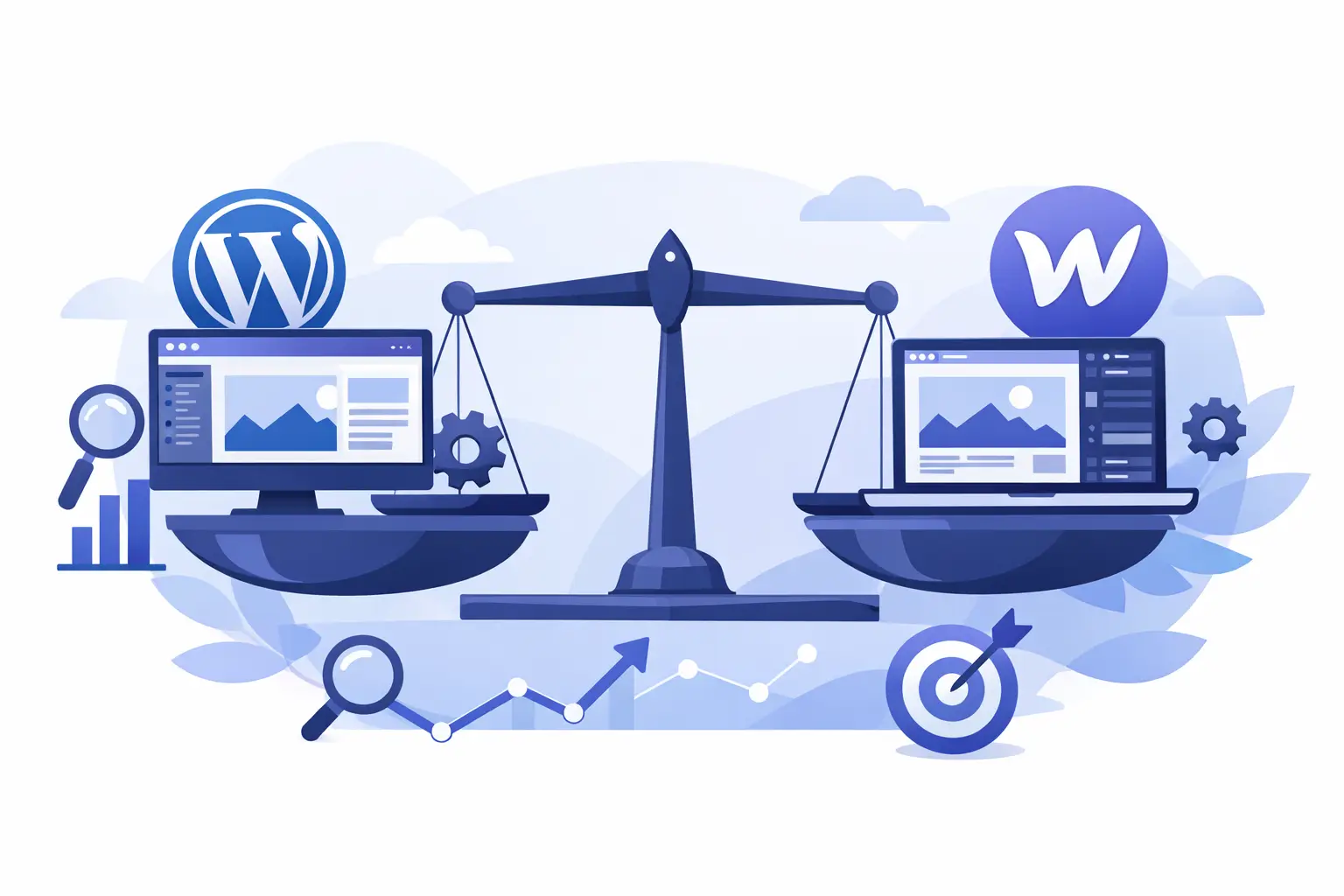
If your website is supposed to generate calls, form fills, and booked jobs, the wordpress or webflow seo question is not really about design preference. It is about operational fit. The right platform should help you rank, load fast, support local landing pages, and make ongoing optimization easier without creating bottlenecks every time you need to publish, edit, or scale.
That is why this decision matters more than most business owners expect. A website platform is not just a place to host pages. It becomes part of your acquisition system. If the platform slows down content production, creates technical SEO issues, or makes local expansion harder, you feel it in lead volume and revenue.
WordPress or Webflow SEO for local business growth
Both platforms can perform well in search. Neither one automatically wins because of the logo on the login screen. Rankings come from execution – site architecture, content depth, internal linking, schema, local intent alignment, speed, and consistent optimization. But platforms do change how easy or hard that execution becomes.
WordPress is more flexible. Webflow is more controlled. That single difference affects almost every SEO decision after launch.
For a local business trying to rank across multiple services and nearby cities, the real question is this: do you need maximum customization, or do you need a cleaner system with fewer moving parts?
Where WordPress has the edge
WordPress is still the strongest option for businesses that need scale, customization, and a deep SEO stack. If you are building a site that needs service pages, city pages, blog content, schema controls, integrations, custom functionality, and room to expand, WordPress usually gives you more headroom.
That matters for local SEO because local campaigns often grow wider over time. You may start with five service pages and one city page, then realize you need location modifiers, FAQ content, review schema, lead magnets, tracking scripts, conversion testing, and content clusters built around high-intent search terms. WordPress can support that without forcing awkward workarounds.
Its plugin ecosystem is part of the appeal, but also part of the risk. You can add strong SEO tools, schema management, image optimization, redirects, caching, and advanced tracking. You can also create a fragile mess if too many plugins stack on top of each other or the site is built without discipline. WordPress is powerful because it is open. It is also easier to break because it is open.
For businesses with a real SEO program behind the site, that flexibility is often worth it. A well-engineered WordPress build can be fast, clean, scalable, and highly compatible with local SEO requirements. A poorly managed one becomes bloated fast.
Where Webflow has the edge
Webflow tends to win on simplicity, design control, and cleaner baseline performance. It is a strong option for businesses that want a polished marketing site without relying on a large plugin stack or developer-heavy maintenance.
From an SEO operations perspective, Webflow removes a lot of common WordPress failure points. Hosting is managed. Core performance is generally stable. Many technical tasks are easier to control without third-party tools. That can be useful for a local business owner who wants fewer maintenance headaches and a site that is less likely to degrade over time.
Webflow is especially attractive when the site structure is relatively straightforward. If you need a clean brochure site, a focused services build, or a manageable number of landing pages, it can work well. The editing experience is also friendlier for teams that want to make content updates without worrying about breaking templates or plugin conflicts.
The trade-off is ceiling, not floor. Webflow can absolutely rank. But once SEO requirements become more complex, especially around large-scale content operations, nuanced schema needs, or custom programmatic page systems, it can feel tighter than WordPress.
Technical SEO: both can work, but control matters
Technical SEO is where platform conversations often get simplified too much. People say Webflow is better because it is faster, or WordPress is better because it has more tools. Both statements are incomplete.
A Webflow site often starts cleaner out of the gate. That helps. But clean code alone does not create rankings. You still need proper heading structure, crawlable architecture, canonical control, redirect management, image optimization, schema, indexation decisions, and page intent alignment.
WordPress gives more technical flexibility, especially if your team knows how to configure it correctly. You can fine-tune almost anything. That is useful for advanced SEO programs, but it also means the build quality matters a lot more. One bloated theme or plugin-heavy setup can undo the advantage.
For local businesses, technical SEO should support visibility in map-influenced search and organic local packs. That means location relevance, service relevance, structured data, mobile performance, and pages that clearly match what people search. Platform choice matters less than whether your team can implement those elements consistently.
Content production and local landing pages
This is where the wordpress or webflow seo decision becomes very practical. Local growth usually comes from keyword breadth. You need pages for core services, related services, city modifiers, and supporting content that captures mid-funnel and top-funnel demand.
WordPress is generally better for aggressive content expansion. It handles large publishing workflows more naturally, especially when SEO is a long-term operating system rather than a one-time project. If your growth plan includes publishing often, building clusters, or targeting many service-area combinations, WordPress is usually the easier platform to scale.
Webflow can handle content strategy, but it is better suited to controlled growth than content sprawl. If your footprint is smaller and your site architecture will stay tight, that may be perfectly fine. If you plan to build dozens or hundreds of location and service pages over time, WordPress tends to be the safer long-term bet.
Design freedom vs SEO governance
Webflow gives designers a lot of control. That can produce sharp websites. It can also create SEO inconsistencies if design decisions outrun search strategy. Local business sites do not need to be plain, but they do need discipline. Strong page templates, clear hierarchy, and conversion-focused layouts usually outperform overly custom page-by-page creativity.
WordPress has the same risk in a different form. Because it is so flexible, businesses often add features without thinking through how those features affect speed, crawlability, or conversion flow.
The platform is not the governor. Your process is. The businesses that get results are the ones that treat the website like infrastructure – not a one-time design deliverable.
Which platform is better for lead generation?
If the goal is lead generation, the better platform is the one your team can operate consistently while improving rankings, speed, and conversion rate over time.
Choose WordPress if you need deeper customization, broader content scale, advanced integrations, and room for a more engineered SEO system. It is usually the stronger fit when your website is central to a serious local acquisition strategy.
Choose Webflow if you want a cleaner maintenance environment, a design-forward site, and a simpler operating model with fewer technical failure points. It works best when the marketing stack is focused and the SEO plan does not require heavy customization.
For many local businesses, WordPress wins because local SEO growth rarely stays simple. Once you start targeting more services, more geographies, and more search intent variations, flexibility starts to matter. But that does not mean Webflow is a bad choice. It means you should choose based on the complexity of the system you plan to run, not on which platform is trending.
The real decision behind wordpress or webflow seo
Most businesses ask which platform is better for SEO when the better question is who will manage the system after launch. A strong strategy on either platform beats a neglected site on the “better” one every time.
If your team needs a scalable engine tied to rankings, lead flow, attribution, and ongoing optimization, platform choice should support that operating model. At Avathan, that is how we frame the build from day one – as part of a measurable acquisition system, not just a web project.
Pick the platform that matches your growth plan, your operational discipline, and the level of SEO complexity your market demands. Then commit to execution. That is where the wins actually come from.
A website should make confident decisions easier, not harder. If your current platform is fighting your SEO process, that friction will keep showing up in traffic, leads, and missed local demand.