

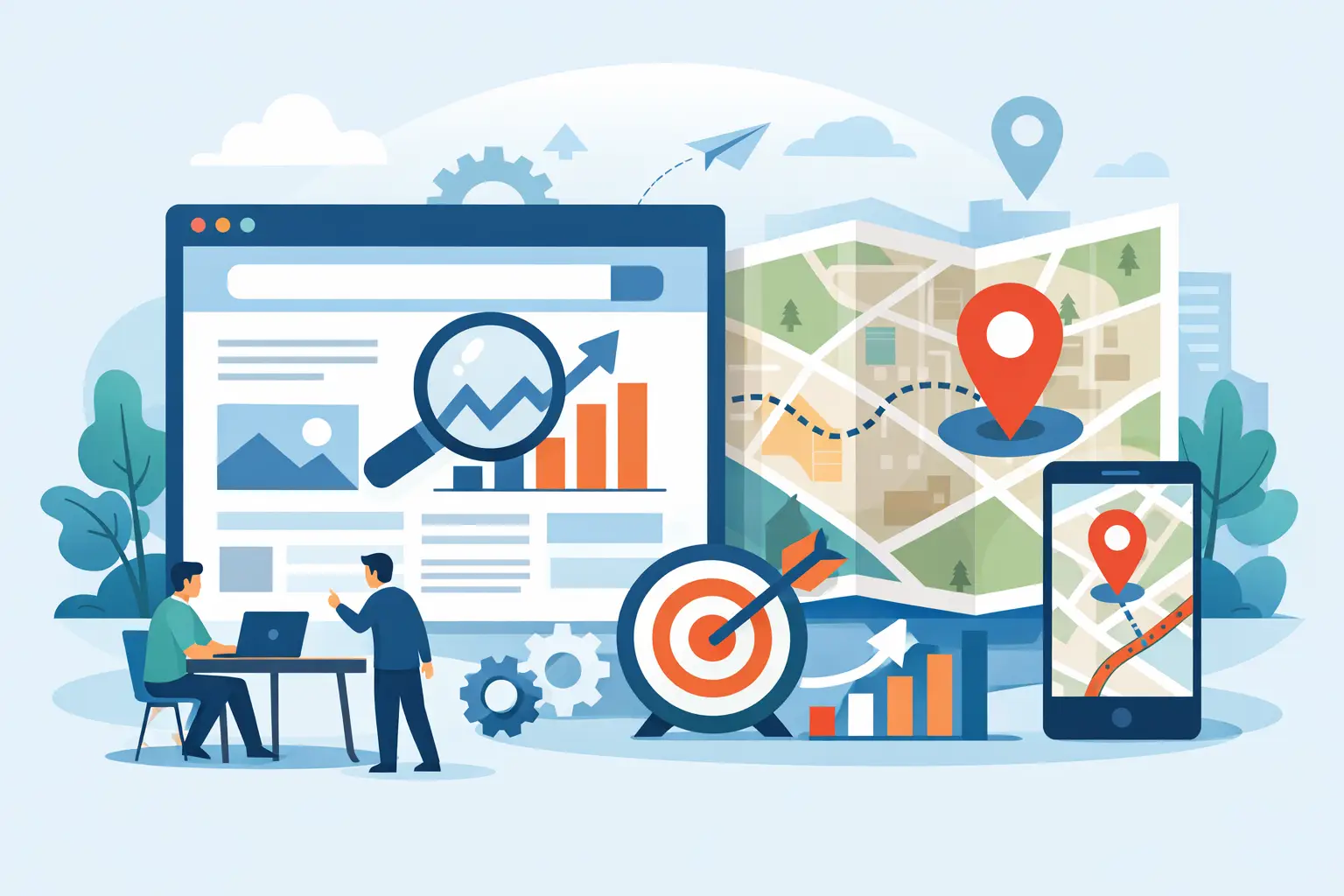
A local business website should do more than look credible. It should create demand capture: rank for the services and locations that matter, direct visitors toward a call or form fill, and give leadership a clear view of what is producing revenue. That is the job of website development SEO.
Too many businesses treat website design and SEO as separate projects. First, they launch a polished site. Then, months later, they ask why it does not rank or generate qualified leads. By that point, the navigation, page templates, content structure, speed, and tracking may all need rework.
The better model is to engineer the site as the operating layer of your organic acquisition system from day one.
Website Development SEO Is a Lead System
A website built for SEO is not a collection of pages targeting isolated keywords. It is an organized system that connects search demand to a local business’s services, service area, proof, conversion paths, and reporting.
For a plumber, that may mean separate, useful paths for water heater repair, drain cleaning, and emergency service. For a law firm, it may mean practice-area pages supported by location relevance, attorney authority, and clear consultation actions. For a contractor, it means showing Google and potential customers exactly what work the company performs, where it performs it, and why it is a credible choice.
The objective is not traffic for its own sake. Organic traffic that cannot convert, cannot be attributed, or comes from outside the real service area does not solve a growth problem. The objective is qualified visibility that harvests calls, form submissions, booked appointments, and in-person visits.
That requires development decisions and SEO decisions to happen together.
Start With Search Demand, Not a Design Mockup
Most website projects begin with a visual preference: a competitor’s site, a color palette, a homepage layout. Those inputs have value, but they are not the foundation of a lead-generating website.
Start with the demand map. Identify the services customers search for, the language they use, the cities and neighborhoods that create revenue, and the questions that appear before someone contacts a provider. Then organize those opportunities by intent.
High-intent searches typically deserve dedicated landing pages. A person searching for “commercial HVAC repair” has a different need than someone searching for “how often should an AC unit be serviced.” Both can matter, but they should not be forced onto the same page with the same conversion expectation.
A practical site architecture usually includes core service pages, location or service-area pages where they are genuinely useful, supporting educational content, trust-building pages, and a conversion path that remains visible throughout the site. The exact page count depends on service breadth, competition, and market size. Publishing dozens of thin city pages is not a strategy. Building pages that answer real local search intent is.
Build for Keyword Breadth Without Creating Clutter
Keyword breadth is how a business captures more than one narrow version of its primary service. It accounts for service variations, problem-based searches, comparison searches, commercial versus residential intent, and local modifiers.
The mistake is trying to place every phrase on the homepage. That creates vague copy, weak relevance, and an unfocused user experience. Instead, assign keyword themes to the pages best equipped to serve them.
A strong service page can rank for a meaningful cluster of related terms because it explains the service, addresses common concerns, demonstrates experience, defines the next step, and is technically easy to crawl. One well-built page can create more value than five shallow pages written only to increase URL count.
Technical Performance Is Part of the Sales Process
Search engines need to discover, render, understand, and trust your website. Prospects need it to load quickly, work on a phone, and make contact without friction. Website development SEO handles both requirements at the same time.
Site speed is a clear example. A slow mobile experience can reduce engagement before a visitor sees your offer. It can also limit crawl efficiency and weaken the quality signals that support organic performance. Large images, unnecessary scripts, bloated themes, poor hosting, and careless plugin use often create problems that are preventable during development.
Technical compatibility also includes clean URL structures, logical internal linking, responsive design, indexation controls, XML sitemaps, canonical tags, redirects, and consistent page hierarchy. These are not glamorous deliverables, but they determine whether the content investment can perform.
Schema implementation deserves the same discipline. Structured data can help search engines interpret the business, its services, locations, reviews, FAQs, and other relevant entities. It is not a ranking shortcut, and it will not compensate for weak content or poor service delivery. It is a clarity layer that supports a technically complete site.
Local Relevance Must Be Earned on the Page
Local businesses often assume adding a city name to a title tag is enough to compete in map and organic results. It is not.
Search engines evaluate a wider set of signals: the business’s relevance to the query, the usefulness of the page, location consistency across the site, local authority, and the overall credibility of the organization. Your website should make these signals easy to understand without repeating city names until the copy becomes unreadable.
Show the markets you serve, but be precise. Include real examples of local work when appropriate. Explain service limitations and response areas. Feature testimonials, credentials, case evidence, and team details that reduce buyer uncertainty. A location page should be useful to someone in that market, not a lightly edited duplicate with a different ZIP code.
This is where geo-targeting becomes operational rather than cosmetic. The goal is to align pages with the geographic areas that have actual demand, reasonable conversion potential, and strategic value for the business.
Conversion Paths Need Engineering, Too
Ranking is only the first half of the equation. If the site creates confusion after the click, the business pays for visibility without receiving its value.
Every major page should answer three questions quickly: What does this business do? Why should I trust it? What should I do next? The answer may be a phone call, estimate request, appointment form, consultation, or text opt-in. The right action depends on the sales cycle.
A 24-hour emergency service business may prioritize click-to-call actions. A high-ticket remodeling company may need a form that qualifies project scope, timeline, and location. A medical practice may require scheduling pathways that protect privacy and reduce administrative friction. There is no universal conversion layout, but there should always be an intentional path.
Keep forms proportionate to intent. Asking for ten fields before a customer can request a basic quote creates unnecessary drop-off. Asking for too little information can burden the sales team with unqualified inquiries. The right balance comes from measuring lead quality, not simply maximizing form completions.
Measure Revenue Signals, Not Just Rankings
Rankings are diagnostic metrics. They can indicate whether your content and technical strategy are gaining visibility. They are not the final score.
A performance-oriented website should connect organic sessions to calls, forms, booked appointments, and qualified opportunities wherever the business can track them. That includes clean analytics configuration, conversion events, call tracking when appropriate, CRM attribution, and reporting that separates meaningful leads from noise.
This visibility changes decision-making. Instead of asking whether SEO is “working,” leadership can evaluate which service pages create qualified demand, which locations are underperforming, where leads decline in the funnel, and what content or technical work deserves the next investment.
Forecasting becomes more credible when it is built on this data. No agency can guarantee a specific ranking or revenue number in a changing search landscape. But a structured model can estimate opportunity from search demand, click-through rates, conversion rates, lead quality, and close rates. That gives operators a basis for making confident decisions.
AI and GEO Change the Content Standard
Traditional search results are no longer the only discovery surface. AI-generated answers and generative search experiences increasingly summarize businesses, services, comparisons, and local options before a user reaches a website.
That does not eliminate the need for technical SEO or local landing pages. It raises the standard for clarity, entity consistency, firsthand proof, and useful content. A business needs pages that make its services easy to interpret for search engines and AI systems while remaining persuasive to real people.
Generic content is less defensible in this environment. Businesses that document real expertise, define services clearly, answer buyer questions directly, and maintain accurate business information are better positioned to be understood and cited across evolving search experiences.
Website development SEO should therefore be treated as ongoing performance engineering, not a launch checklist. Search behavior changes. Competitors improve. Services expand. Conversion data exposes friction. The site needs a system for responding.
A website that ranks but does not produce leads is a missed opportunity. A website that produces leads but cannot explain where they came from is difficult to scale. Build the structure, tracking, speed, local relevance, and conversion paths together, then keep improving what the numbers reveal.