

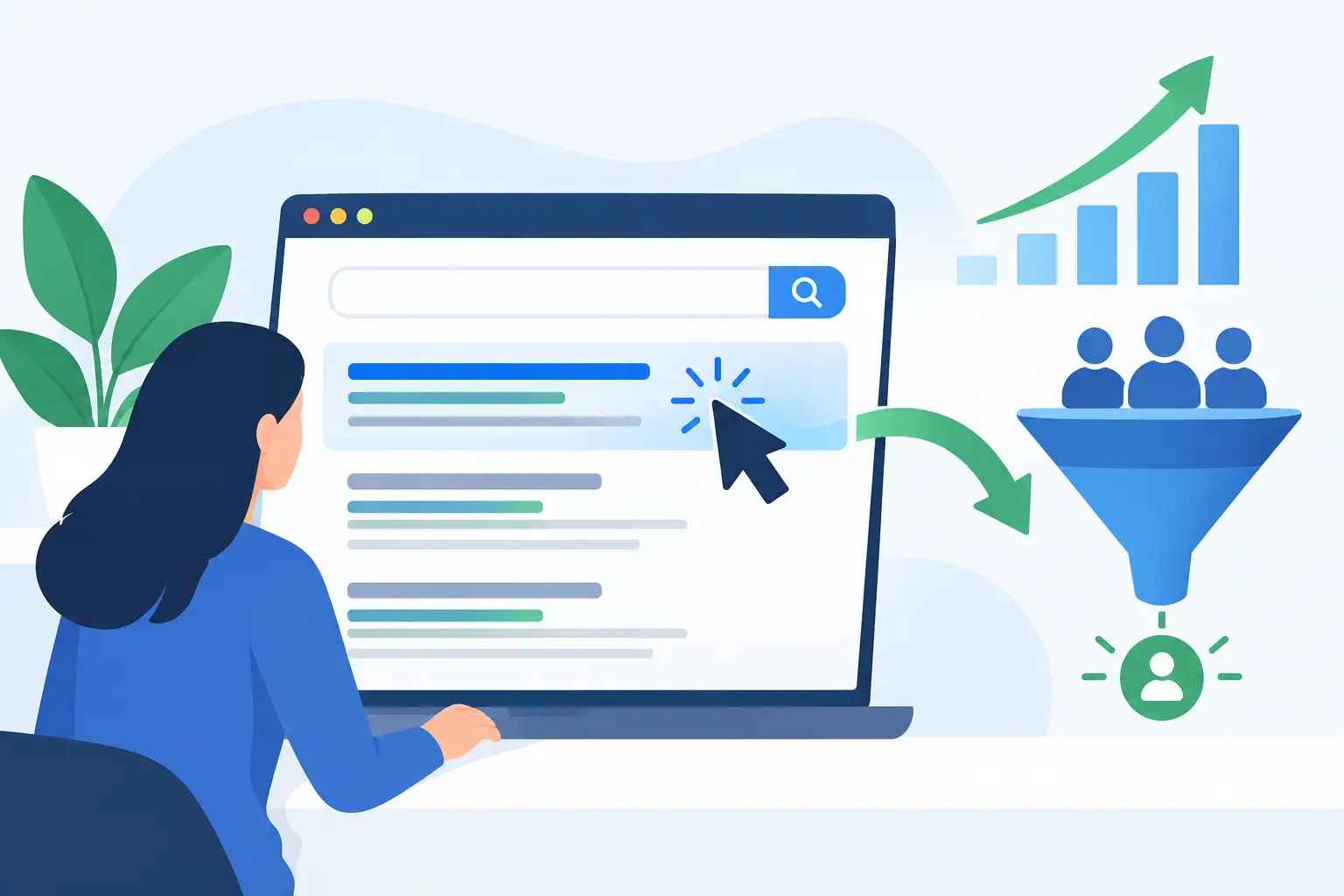
A local business can hold a top-three ranking and still lose the lead. The reason is simple: searchers do not click rankings. They click the result that looks most relevant, credible, and ready to solve their problem. SERP click through optimization is the work of improving that decision point so more qualified search impressions become calls, form fills, direction requests, and booked jobs.
For operators, this is not a copywriting exercise detached from performance. It is a conversion layer inside your organic acquisition system. If your website earns 10,000 monthly impressions but only 2% of searchers click, a better result presentation can create meaningful traffic before you spend another dollar on ads or publish another dozen pages.
What SERP Click Through Optimization Actually Means
Search engine results pages are crowded. A prospective customer may see paid ads, map listings, AI-generated answers, directories, review platforms, and organic results before reaching your site. Your listing has a few seconds to establish relevance.
SERP click through optimization improves the elements people see before visiting your website: page titles, meta descriptions, visible URLs, dates when relevant, rich results, review signals, local relevance, and the alignment between the search query and your page. The objective is not to chase clicks from everyone. It is to earn more clicks from people who have a real reason to contact your business.
That distinction matters. A vague title can attract curiosity clicks that immediately bounce. An overly aggressive promise can create traffic while damaging trust. The right result sets a clear expectation, brings in the right visitor, and gives the landing page a fair chance to convert.
Why Click-Through Rate Affects Local Growth
A higher organic click-through rate increases the return on work you already own: rankings, indexed pages, brand awareness, and search impressions. For local businesses, that can mean more estimate requests without expanding the media budget.
Consider a service page that receives 3,000 impressions each month for high-intent searches. Moving its click-through rate from 2.5% to 4% produces 45 additional visits. If that page converts qualified visitors at 8%, those extra visits can create three to four more leads per month. The business case becomes clearer when the query represents a high-ticket service.
Click-through rate is not a direct ranking lever you can manipulate in isolation. Search engines evaluate many signals, and correlation is not proof that clicks alone cause higher rankings. Still, results that better match intent tend to earn engagement, while strong landing pages support satisfaction after the click. Treat CTR as a performance metric to improve, not a shortcut to game.
Start With Query Intent, Not Clever Headlines
The best title tag depends on what the searcher is trying to do. Someone searching “emergency plumber near me” needs availability, location, and urgency. Someone searching “water heater replacement cost” needs pricing context and decision support. Someone searching your brand name needs confidence that they found the official business.
A page title should reflect the dominant intent in plain language. It should also include the service and geographic signal when that information helps the searcher choose. “Roof Repair in San Antonio | Same-Day Inspections” is stronger than “Trusted Roofing Solutions for Every Need” because it answers the immediate question: what do you do, where do you do it, and why should a customer click now?
Do not force the same city name into every title. For broad informational content, it can make the snippet feel unnatural. For high-intent local service pages, geo-targeting is often a material advantage. The correct approach depends on the page’s role in your keyword map.
The SERP Click Through Optimization System
CTR improvements should be prioritized like any other growth initiative. Start with data, isolate opportunities, deploy changes, and measure the outcome over a meaningful period.
Find Pages With High Impressions and Weak CTR
Search performance data identifies the pages and queries where optimization can create the most leverage. Look for pages with substantial impressions, an average position that gives them a realistic chance to win clicks, and a click-through rate below what comparable results may earn.
Pages ranking in positions three through eight are often productive candidates. They already have visibility but may be losing attention to stronger titles, better-known brands, richer snippets, or results that communicate value more clearly. A page in position 45 has a ranking problem first. A page in position four with a thin snippet has a presentation problem worth testing.
Segment the data before acting. Brand queries, informational queries, service queries, and local queries behave differently. A 15% CTR may be weak for a branded search and excellent for a broad, non-branded research query. Compare like with like.
Rewrite Titles for Relevance and Differentiation
A title tag should lead with the service or topic a searcher expects, then add a meaningful differentiator where space allows. Useful differentiators include service area, response speed, pricing clarity, specialization, credentials, or a concrete offer. Empty adjectives such as “best,” “leading,” and “premier” usually consume space without building belief.
Avoid title tag stuffing. Repeating the same keyword and city name can trigger truncation, reduce readability, and signal low quality. One clear phrase is better than a chain of variations designed for a crawler rather than a customer.
Keep an eye on what is already winning the result page. If every competitor says “Free Estimate,” repeating it may not change the decision. If competitors hide their service area or response timeline, a precise local message can create separation.
Use Meta Descriptions to Qualify the Click
Google may rewrite meta descriptions, so they are not a guaranteed piece of SERP copy. They still provide direction about how you want a page presented and frequently appear when they closely match the query.
Strong descriptions add detail the title does not cover. They can clarify the service, city coverage, proof point, and next step. For example, a local HVAC page might mention licensed technicians, same-day repair availability, and a request-an-estimate action. The goal is not to fit every selling point into 155 characters. It is to make the click feel justified.
Descriptions should match the landing page. If the snippet promises emergency service, the page should make availability easy to verify and the contact path immediate. Misalignment lifts clicks temporarily and wastes them afterward.
Earn Rich Results With Clean Technical Foundations
Structured data can help search engines understand a business, its services, reviews, FAQs when appropriate, and other page details. It does not guarantee a rich result, and it should never be used to mark up information that is hidden, inaccurate, or ineligible. But valid schema implementation strengthens technical clarity and can improve how eligible pages appear.
Technical performance also affects the value of every click. A searcher who lands on a slow, unstable, or confusing mobile page is unlikely to call. SERP optimization and on-site optimization belong in the same operating system: one wins the visit, the other harvests the lead.
Measure Lead Quality, Not Just More Clicks
The correct scorecard goes beyond CTR. Track impressions, average position, clicks, engaged sessions, calls, form submissions, booked appointments, and revenue where attribution permits. A title change that increases traffic by 30% but produces no additional qualified leads is not a win.
This is particularly important for businesses with multiple service lines. A broad “services” title may draw volume, while a focused title for a profitable specialty can drive fewer but better leads. Forecasting should account for expected click growth, landing-page conversion rate, close rate, and average job value. That is how a marketing decision becomes defensible to leadership.
Allow enough time to measure. Search results fluctuate by device, location, seasonality, and changes in the result page itself. Document the original title and description, the deployment date, target queries, and the outcome. Do not change ten variables at once and then guess which one worked.
Where AI and Local Search Change the Equation
AI Overviews and other answer-first experiences can reduce clicks for simple questions. That does not make organic optimization less valuable. It makes intent selection more important. Local businesses should build content that answers research questions while maintaining strong visibility for searches that require a provider, a quote, an appointment, or local verification.
Generative engine optimization also rewards clear entity signals. Your business name, location, services, service areas, credentials, and supporting evidence should be consistent across the site. When search systems can confidently understand who you are and what you do, your pages are better positioned to appear for relevant local demand.
The practical move is to stop treating the SERP as a finish line. Treat it as your first conversion screen. Every title, description, schema decision, and landing-page promise should help a qualified customer make one confident next move: choose your business.