

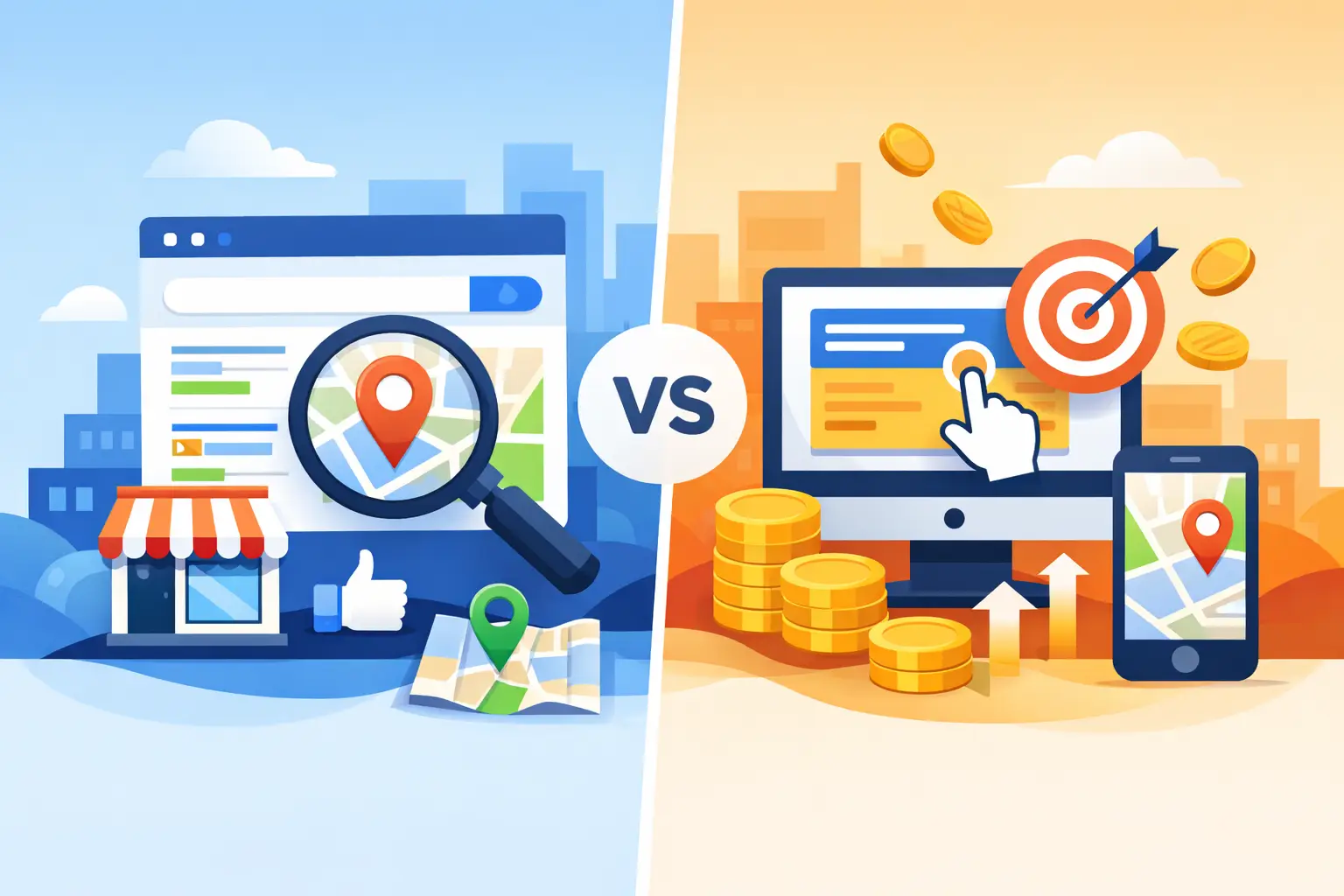
A local service business can spend $3,000 on ads this month and see calls tomorrow. It can also invest that same budget into local SEO and build visibility that continues producing calls after the initial work is complete. That is the practical decision behind local SEO vs PPC: do you need immediate demand capture, durable organic acquisition, or a system that uses both without wasting budget?
For most local businesses, this is not a channel preference debate. It is a forecasting, attribution, and capacity decision. The right mix depends on your market, margins, sales cycle, website performance, and the number of qualified leads your team can actually handle.
Local SEO vs PPC: The Core Difference
Local SEO earns visibility in organic search results, Google Maps, and other location-driven search experiences. The objective is to appear when people search for services in your area, such as “emergency plumber near me,” “roof repair in San Antonio,” or “commercial electrician nearby.” You do not pay for each click, but you do invest in the website, content, technical foundation, Google Business Profile, local authority, and ongoing optimization required to compete.
PPC, or pay-per-click advertising, buys placement. Your business can appear at the top of search results for selected keywords, locations, audiences, and times of day. You pay when someone clicks, and your visibility can begin as soon as campaigns are approved and funded.
The distinction matters because each channel creates a different asset. PPC rents attention. Local SEO builds an acquisition engine your business owns. One is fast and controllable; the other compounds over time. Neither is automatically better.
When PPC Is the Right Move
PPC is built for speed. If your phones are quiet, a new location needs leads, or a seasonal service window is approaching, paid search can put an offer in front of active buyers quickly. It also provides a controlled environment for testing messages, landing pages, service demand, and geographic pockets before committing to a larger organic content plan.
For example, a restoration company may need calls after a storm event. A legal practice may need consultations for a specific case type. A med spa may be promoting a new service with limited appointment availability. In these cases, waiting months for organic rankings can leave revenue on the table.
PPC also gives operators clearer short-term levers. You can increase budget, reduce it, pause underperforming search terms, adjust radius targeting, and route traffic to a focused landing page. That control is valuable when leadership needs a measurable response within days or weeks.
But the cost structure needs discipline. High-intent local keywords can be expensive, especially in legal, home services, healthcare, and financial services. A campaign that generates clicks but lacks call tracking, form attribution, negative keyword management, and conversion-focused landing pages can consume budget without producing booked work.
PPC works best when the economics are clear
Paid search should be measured against revenue, not impressions or click-through rate alone. If a lead costs $150 but produces a $2,500 job with healthy margins, the channel may be highly profitable. If that same $150 lead turns into a low-value inquiry your team rarely closes, scaling spend simply scales waste.
Before increasing PPC budget, establish a baseline for cost per qualified lead, booked appointment rate, close rate, average customer value, and lead response time. A campaign cannot compensate for unanswered calls or a sales process that fails to follow up.
When Local SEO Is the Better Investment
Local SEO is the stronger long-term move when customers consistently search for your services and your business wants to reduce dependence on paid media. It is particularly valuable for service companies with multiple core offerings, defined service areas, and recurring demand throughout the year.
A properly built local SEO program expands keyword breadth. Instead of depending on a handful of paid terms, your site can compete across service-specific, city-specific, problem-specific, and comparison searches. That creates more entry points for prospects who are researching, ready to call, or trying to validate a provider before they choose.
The work starts with fundamentals that many businesses underestimate: site speed, mobile usability, crawlability, schema implementation, clean information architecture, accurate service area signals, and pages that match real search intent. Then comes the ongoing work of improving local relevance, publishing useful service content, strengthening entity signals, and measuring what produces qualified demand.
Organic visibility does not appear on a fixed schedule. A business in a lightly competitive market may gain traction quickly. A company trying to outrank established competitors in a major metro may need a longer runway. Google Maps results are especially competitive because proximity, relevance, prominence, reviews, category choices, and user behavior all influence visibility.
SEO creates compounding value, not instant certainty
The major advantage of local SEO is that strong pages, technical improvements, local authority, and conversion assets can continue generating leads without a charge for every visitor. That lowers marginal acquisition cost over time and gives your business more control over its demand generation.
The trade-off is patience. SEO is not a switch to flip when the pipeline is empty. It is a structured operating system that needs consistent execution and measurement. Businesses that treat it as a one-time website project often lose momentum before the channel has a chance to compound.
The Website Determines Whether Either Channel Performs
Local SEO and PPC both fail when traffic lands on a slow, confusing, generic website. Search engines may send visitors, but visitors still need a reason to call, submit a form, or request an estimate.
A high-performing local site makes the next step obvious. It confirms the service, location, credibility, availability, and outcome the searcher cares about. It loads quickly on a phone, displays clear contact paths, and uses conversion tracking that connects calls and form fills back to the channel and campaign that produced them.
This is why separating website development from acquisition strategy often creates avoidable friction. A website is not just a digital brochure. It is the conversion layer for every search investment. Technical compatibility, page speed, schema, location architecture, and messaging all affect the return on both organic and paid traffic.
Use PPC Data to Build a Smarter SEO Roadmap
The strongest local growth programs do not force an either-or decision. They use PPC to surface immediate demand and local SEO to capture that demand more efficiently over time.
Paid search data can reveal which services, neighborhoods, questions, and offers produce qualified leads. If a specific service keyword converts at a strong rate, that is a signal to build or improve the related organic service page. If searches from a nearby city produce profitable jobs, that market may deserve geo-targeted content and a more deliberate local visibility strategy.
SEO data works in the other direction as well. When organic rankings are weak for a high-value service, PPC can protect lead flow while the organic program develops. When a page begins ranking consistently and generating calls, paid budget can be shifted toward more competitive terms, seasonal opportunities, or new service lines.
This approach prevents channel silos. It turns search data into a shared decision system rather than two separate reports competing for credit.
How AI and GEO Change the Decision
AI-assisted search and generative engine optimization do not eliminate the need for local SEO or paid search. They raise the bar for clarity, trust, technical structure, and topical depth. Search platforms need to understand what your business does, where it operates, why it is credible, and which customer problems it solves.
For local businesses, that means accurate business information, well-structured service pages, real proof of experience, schema markup, fast sites, and content that answers specific questions without vague marketing language. These signals support traditional rankings while making your business easier for search engines and AI-driven answer experiences to interpret.
PPC remains useful in this environment because it still gives businesses direct access to active demand. But paid placement does not replace the credibility built through an authoritative website and consistent local presence. The businesses that win will not chase every new search feature. They will build clean, measurable systems that adapt as search behavior changes.
Choose Based on Your Current Constraint
If the constraint is immediate lead volume, PPC is usually the faster lever. If the constraint is rising acquisition cost and overreliance on ads, local SEO deserves priority. If the constraint is poor conversion performance, fix the website and tracking before aggressively funding either channel.
A practical budget model often starts with enough PPC spend to maintain near-term pipeline while dedicating a meaningful portion of investment to organic infrastructure. As rankings, calls, and attributed revenue improve, the business can make confident decisions about where paid spend is still needed and where organic visibility is carrying the load.
At Avathan, the goal is not to declare a winner between channels. It is to engineer a local acquisition system that shows where leads come from, what they cost, and what revenue they produce. Build the channel mix around your actual economics, then keep improving the parts of the system that move qualified prospects from search to scheduled work.