

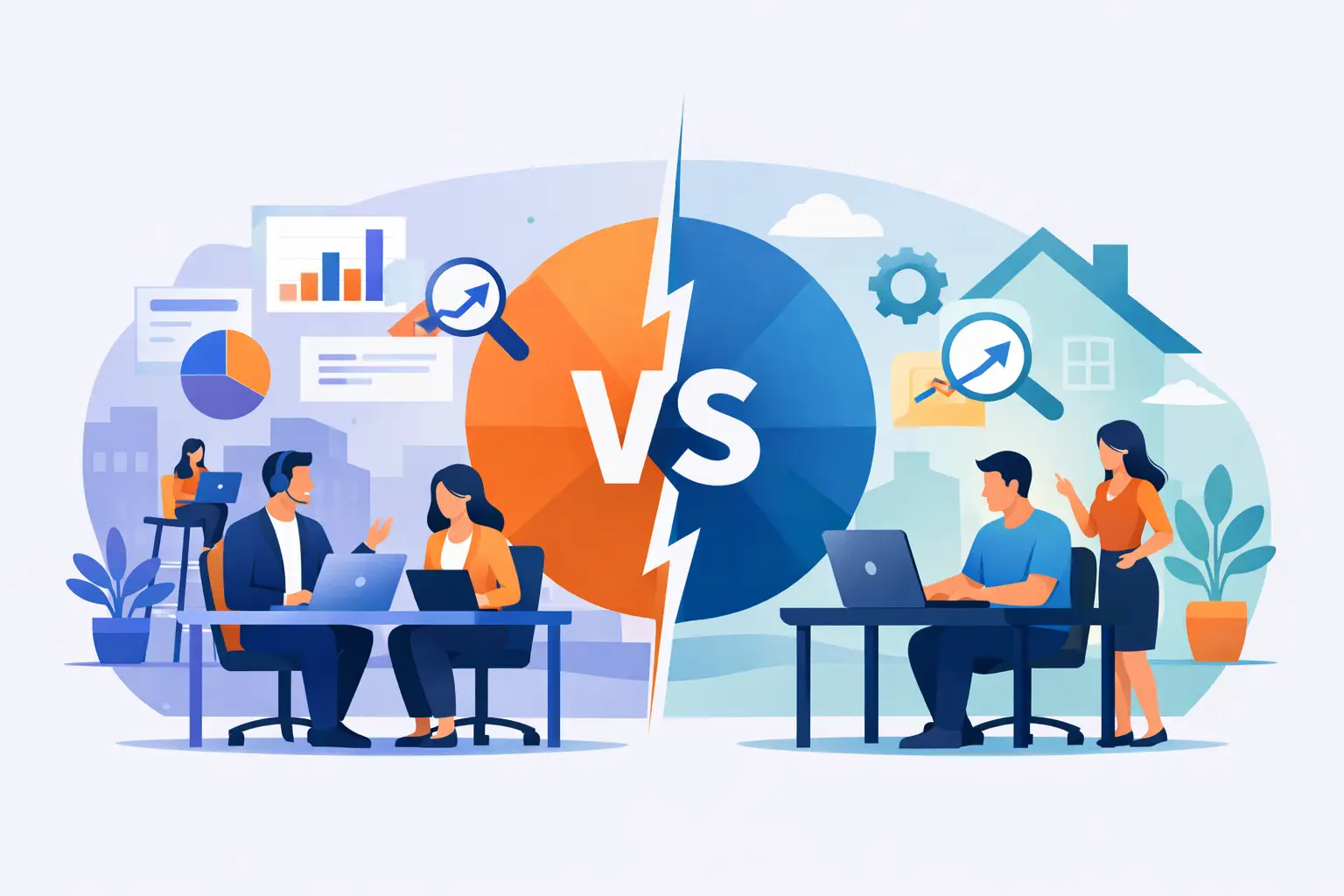
Most local businesses do not lose at SEO because they picked the wrong tactic. They lose because they picked the wrong operating model. That is the real question inside agency vs in house SEO. Are you building an internal function from scratch, or are you buying a system that is already designed to drive rankings, leads, and measurable revenue?
For a local business, this is not a branding debate. It is a production decision. You need pages built correctly, local signals aligned, technical issues resolved, content mapped to buying intent, and performance tracked in a way leadership can actually use. If that work is inconsistent, SEO turns into a cost center. If it is structured well, it becomes a scalable acquisition channel.
Agency vs in house SEO is really about operating leverage
Business owners often frame this choice around cost alone. That is too narrow. The better lens is leverage. Which model gives you the fastest path to execution, the clearest accountability, and the best odds of turning search demand into booked jobs, calls, and form fills?
An in-house SEO hire can bring focus and proximity. They sit with the team, understand the service mix, and can adapt quickly to internal priorities. In the right company, that can be a major advantage. But one person rarely covers the full stack at a high level. Local SEO today is not just title tags and blog posts. It involves technical SEO, content planning, conversion-focused page structure, local landing page architecture, schema, site speed, analytics, attribution, and increasingly AI and GEO visibility.
An agency brings a broader bench. Instead of hiring one person and hoping they can strategize, implement, report, and troubleshoot, you get access to multiple disciplines. That matters when your website needs engineering support, your Google Business Profile strategy needs refinement, and your location pages need to rank without creating thin content.
The trade-off is simple. In-house gives you embedded attention. Agency gives you systemized capacity.
When in-house SEO makes sense
If your company already has a mature marketing department, strong web support, and enough budget to hire specialists rather than a generalist, in-house can work very well. This is especially true if SEO is central to your growth model and you need someone close to sales, operations, and service delivery.
A strong in-house SEO lead can build institutional knowledge over time. They learn which services carry the best margins, which neighborhoods convert best, and which seasonal trends affect lead flow. That context can improve prioritization. They can also collaborate more directly with internal teams on approvals, content gathering, and changes to the website.
But there is a threshold problem. Many small and mid-sized local businesses are not staffed to support in-house SEO properly. They hire one person, then expect them to function as strategist, analyst, writer, developer, local SEO manager, and conversion optimizer. That is not a role. That is five roles compressed into one salary.
When that happens, execution slows down. Reporting gets vague. Technical work gets delayed. Content production becomes reactive. Rankings may improve in isolated areas, but the full engine never gets built.
Where agencies usually outperform
Agencies tend to outperform when a business needs speed, specialized execution, and accountability tied to outcomes. This is especially true for local businesses that need both website performance and SEO performance to work together.
A good agency does not just tell you what to do. It does the work. That sounds obvious, but it is the difference between strategy theater and production. If your service pages need restructuring, your local schema is missing, your site is slow on mobile, and your geo-targeted pages are not aligned to search intent, advice alone will not move revenue.
This is where a systems-oriented agency model becomes valuable. You are not buying random SEO tasks. You are buying an operating system for growth: research, prioritization, implementation, measurement, and iteration. That structure matters because local SEO compounds only when the pieces reinforce each other.
Agencies also have a pattern-recognition advantage. They see what works across service-area businesses, multi-location companies, and competitive local markets. They know the difference between a ranking increase that looks good on a report and one that actually produces calls. They are more likely to catch hidden issues, from duplicate location signals to weak internal linking to service pages that rank but fail to convert.
The real cost question in agency vs in house SEO
On paper, in-house can look cheaper. Salary, maybe a few tools, maybe some freelance support. But the actual cost is usually higher than leaders expect.
You are not just paying compensation. You are paying for recruiting, ramp time, management, software, training, and the risk of hiring someone who is strong in one area and weak in three others. If that person leaves, the program often stalls. Knowledge walks out the door, and momentum resets.
Agency pricing is more visible, which can make it feel more expensive. But visibility is not the same as higher cost. In many cases, a business gets more output per dollar from an agency because the delivery model is already built. The process exists. The tools exist. The specialists exist. The reporting framework exists.
The right financial question is not, which is cheaper this month? It is, which model gets us to revenue-producing execution faster, with fewer mistakes and less internal drag?
Control vs accountability
One of the most common arguments for in-house SEO is control. That is valid. You can set priorities quickly, shift messaging fast, and keep resources close to the business.
But control without throughput is not much of an advantage. If your team controls the roadmap but cannot execute the roadmap, growth still stalls.
Agencies, on the other hand, are often judged on accountability. That is one of their strongest advantages when the relationship is structured well. Clear deliverables, recurring reporting, lead tracking, and performance reviews create pressure to produce. The best agencies tie the work to business outcomes, not just rankings.
That said, not every agency deserves that trust. Some are heavy on jargon and light on implementation. Some hide behind vanity metrics. Some treat local SEO like a checklist rather than a revenue channel. If you choose an agency, you need one that can explain what is being done, why it matters, and how it connects to lead volume, pipeline, and ROI.
What local businesses usually need most
For most local businesses, the winning model is not purely agency or purely in-house. It is often agency-led execution with internal alignment.
That means the agency owns the SEO system: technical fixes, content planning, location targeting, on-page improvements, schema, measurement, and ongoing optimization. The business owner or marketing lead provides operational insight: best services, target markets, sales feedback, close rates, and capacity constraints.
That split works because each side handles what it is best built to do. The business provides context. The agency provides production and optimization discipline.
This is especially effective when leadership wants decisions they can defend with numbers. If SEO is tied to call tracking, form submissions, ranking movement by service area, landing page performance, and conversion trends, it becomes easier to forecast and invest with confidence.
How to choose the right model
Start with your current reality, not your ideal org chart. If you do not have strong web support, analytics discipline, content capacity, and SEO leadership internally, building in-house will take longer than you think. That does not mean it is wrong. It means you need to account for the build time.
If you need results sooner, an agency is usually the faster route. You can launch improvements without spending months hiring, training, and assembling a stack of tools and processes.
Also look at complexity. A single-location business with a simple service mix has very different needs than a multi-service company targeting several cities. As complexity rises, so does the value of specialized execution.
Finally, look at management bandwidth. In-house SEO still needs leadership. Someone has to define priorities, review performance, and remove blockers. If no one internally has the time or expertise to manage that function well, the hire may underperform through no fault of their own.
A practical test is this: do you need a person, or do you need a machine? If you need one smart person to coordinate a mature internal team, in-house can make sense. If you need strategy, implementation, measurement, and continuous optimization working together right now, an agency is often the better fit.
For many local businesses, that is why agency support wins. Not because in-house is bad, but because growth usually depends on execution density. The businesses that gain ground are the ones that publish the right pages, fix the right technical issues, strengthen local relevance, and measure what happens next. Avathan approaches that work like an SEO operating system because local search performance is not a collection of tricks. It is infrastructure.
The best choice is the one that gets your business moving with clarity, speed, and accountability. If your SEO model cannot produce that, it is not really a model. It is a delay.